Canada Basketball Program Benchmark 2026
An Evidence-Based Ranking of Youth Basketball Programs
Why Canadian High-School Basketball Matters
Canada is no longer a peripheral contributor to North American basketball. It has become one of the continent's most important talent-producing systems, with Canadian players increasingly visible at every stage of the pathway - from high school and prep basketball to NCAA competition, national teams, and the NBA.
At the start of the 2025-26 NBA season, Canada was the most represented country outside the United States for the 12th consecutive season. The NBA listed 23 Canadian players on opening-night rosters, while Canada Basketball counted 25 Canadians across NBA rosters more broadly. More important than the count alone is the level of impact: Shai Gilgeous-Alexander became the 2024-25 NBA Most Valuable Player and helped lead Oklahoma City to the 2025 NBA championship. He became the second Canadian to win NBA MVP, following Steve Nash.
The depth extends beyond one superstar. Canadian players such as Jamal Murray, Andrew Wiggins, RJ Barrett, Andrew Nembhard, Bennedict Mathurin, Dillon Brooks, Luguentz Dort, Shaedon Sharpe, and Zach Edey occupy meaningful roles across the league. This shows that Canadian basketball is contributing not only individual stars but also a sustained pipeline of NBA-level talent.
The youth national-team results reinforce the same trend. In June 2026, Canada's U18 men's national team defeated the United States 67-65 in the FIBA U18 AmeriCup final, ending the United States' seven-title streak and giving Canada its first-ever gold medal in the competition. Canada finished the tournament 5-0, and Javion Tyndale was named tournament MVP. The result is particularly significant because it demonstrates that Canada's emerging talent can now compete with - and, in a championship setting, defeat - the traditional benchmark of North American youth basketball.
Women's basketball is also becoming one of the sport's most important growth engines. The expansion is not simply a parallel story to men's basketball: it is bringing new athletes, families, fans, media attention, investment, and professional aspirations into the basketball ecosystem. In Canada, the clearest symbol is the arrival of the Toronto Tempo in 2026 as the country's first WNBA franchise and the league's first team outside the United States.
The early response illustrates the scale of that opportunity. Toronto sold out its inaugural season-ticket memberships before the 2026 season began, and a Tempo game at Montreal's Bell Center drew 20,996 spectators in July 2026, setting a WNBA regular-season attendance record. The WNBA also signed a multi-year Canadian media-rights agreement with Bell Media, expanding national access to Tempo games and the league more broadly.
For youth development, this growth matters directly. A stronger professional women's game creates greater visibility, more role models, and a clearer aspirational pathway for girls who enter basketball at younger ages. Canada's U18 women's silver medal at the 2026 AmeriCup, combined with the emergence of a domestic WNBA franchise, suggests that girls' and women's basketball should be treated as central to Canada's basketball-development story, not a secondary category.
This is also why the Benchmark evaluates Senior Girls and Junior Girls as distinct competitive pathways rather than folding them into a single overall basketball score. A strong modern high-school basketball program should be assessed on whether it creates meaningful development opportunities for both male and female student-athletes.
The rise of Canadian girls’ high-school programs
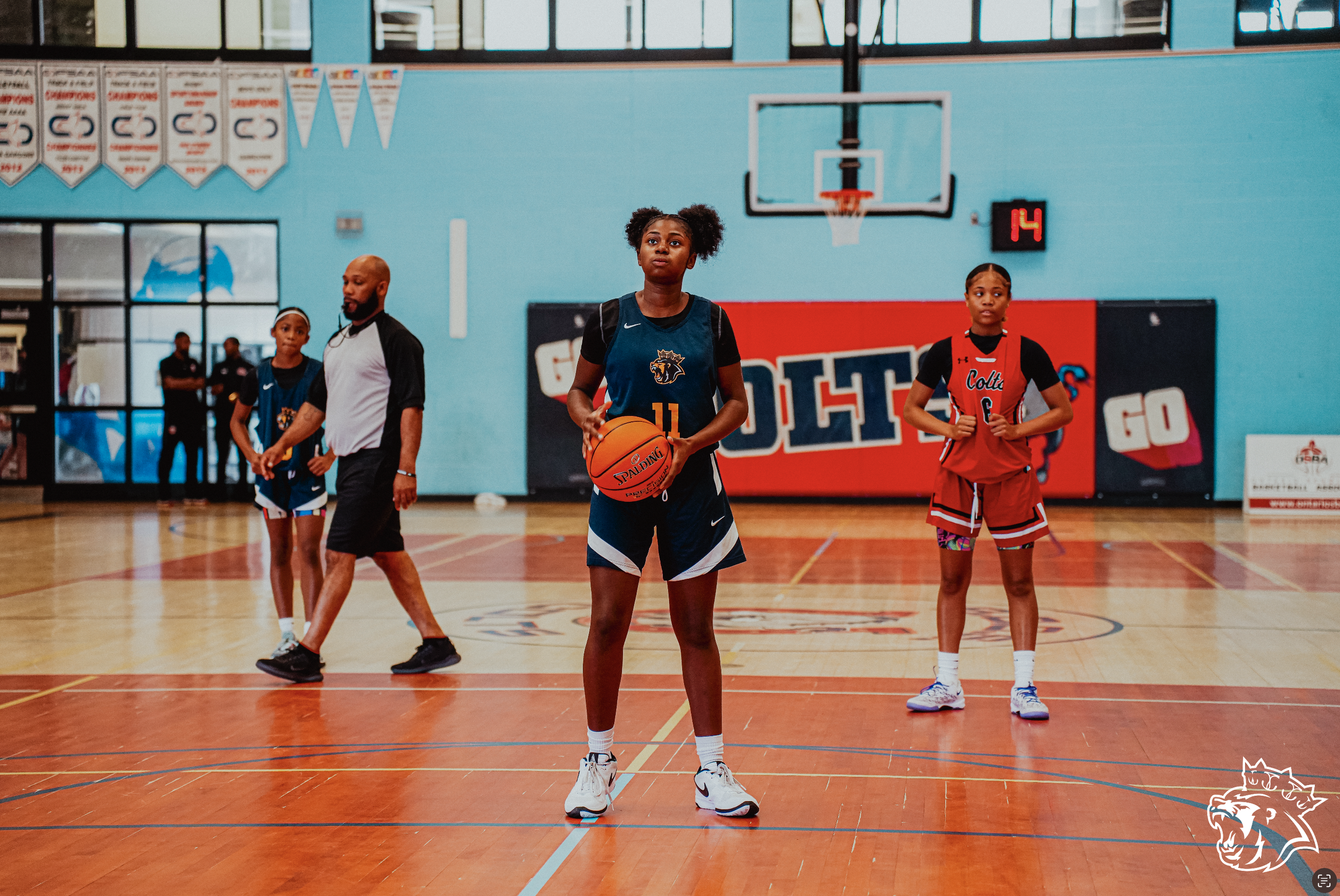
The growth of Canadian girls’ basketball is also becoming visible at the high-school and prep level. In 2026, the Toronto Star profiled Royal Crown School in Scarborough as a “girls basketball powerhouse in North America,” highlighting how Canadian programs are increasingly competing beyond provincial and national boundaries.
The profile connects competitive success with the broader student-athlete pathway: high-performance development, cross-border competition, and progression toward NCAA opportunities. As independent media evidence, it provides a useful example of how leading Canadian girls’ programs are becoming part of a wider North American basketball ecosystem rather than operating only within provincial competition.
For this Benchmark, the significance extends beyond Royal Crown itself. The example illustrates a structural trend in girls’ basketball: stronger Canadian high-school programs can increasingly combine education, elite development, exposure, and North American competition within a single pathway. This reinforces the case for evaluating girls’ programs as a distinct and important component of Canada’s basketball-development system.
Toronto Star — Royal Crown Girls Basketball Profile — Independent media source: “Inside the Scarborough school that’s become a girls basketball powerhouse in North America.”
These outcomes do not mean that every elite Canadian player develops through the same school or league. They do, however, show why the Canadian high-school and prep ecosystem matters. The high-school years are a critical point where athletes combine daily development, competition, education, exposure, and preparation for the next level. Ontario's OSBA model is specifically designed around that intersection: stronger training and competition, athlete and coach development, exposure, and preparation for provincial, national, and international competition.
The timing also aligns with Canada Basketball's Long-Term Development framework, which places adolescent athletes within important Train-to-Train and Train-to-Compete stages. The scholastic environment can therefore play a meaningful role in a broader North American pathway: Canadian high-school programs develop athletes inside Canada's system while simultaneously connecting them to NCAA, U Sports, national-team, and U.S. competition opportunities.
OSBA's D-League extends this pathway to Grade 9-10 athletes, creating a structured development step toward senior high-performance basketball. This makes program depth - not only the quality of a school's top senior team - relevant when families evaluate where a young athlete should develop.
Benchmark Purpose & Scope
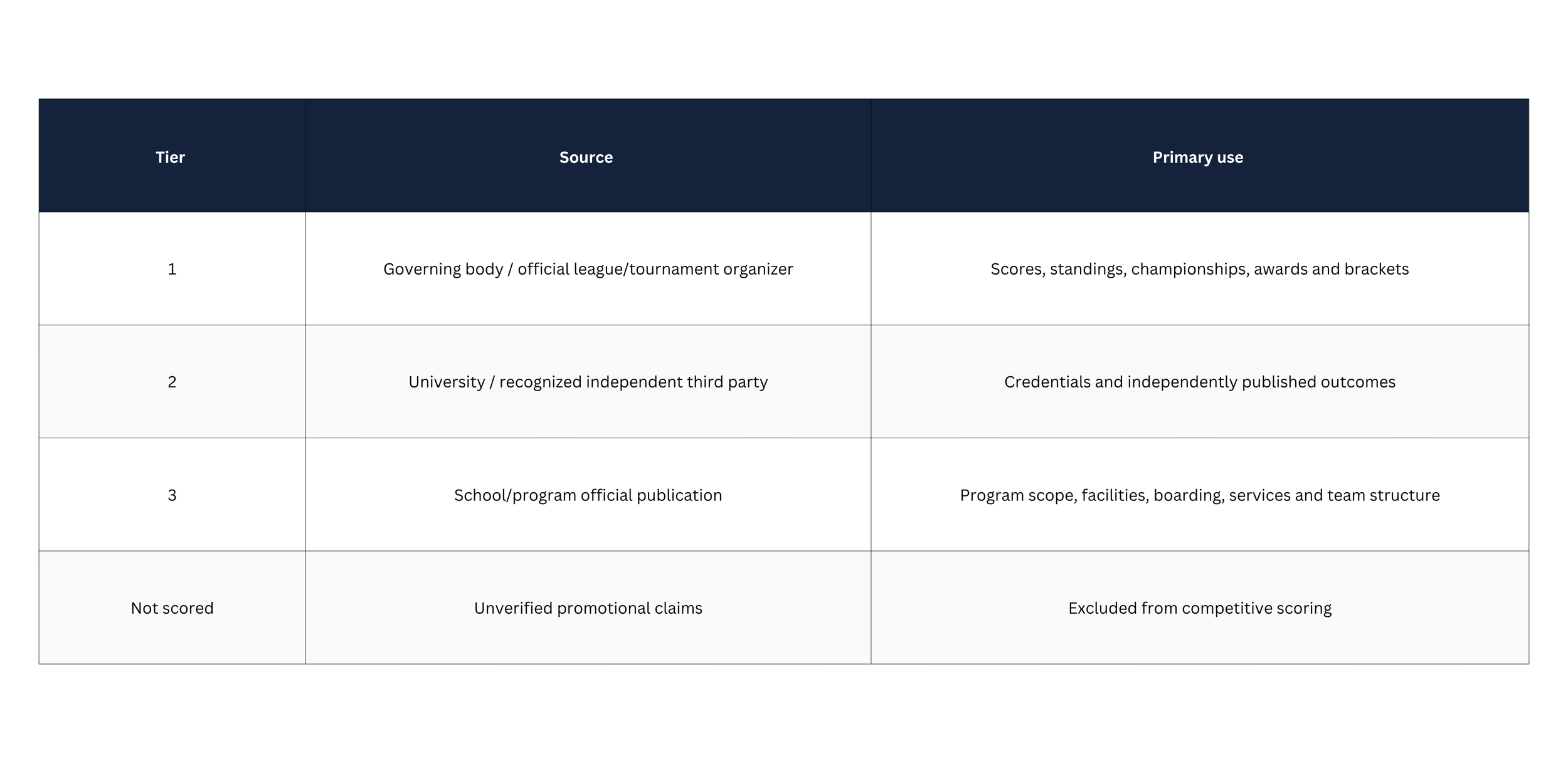
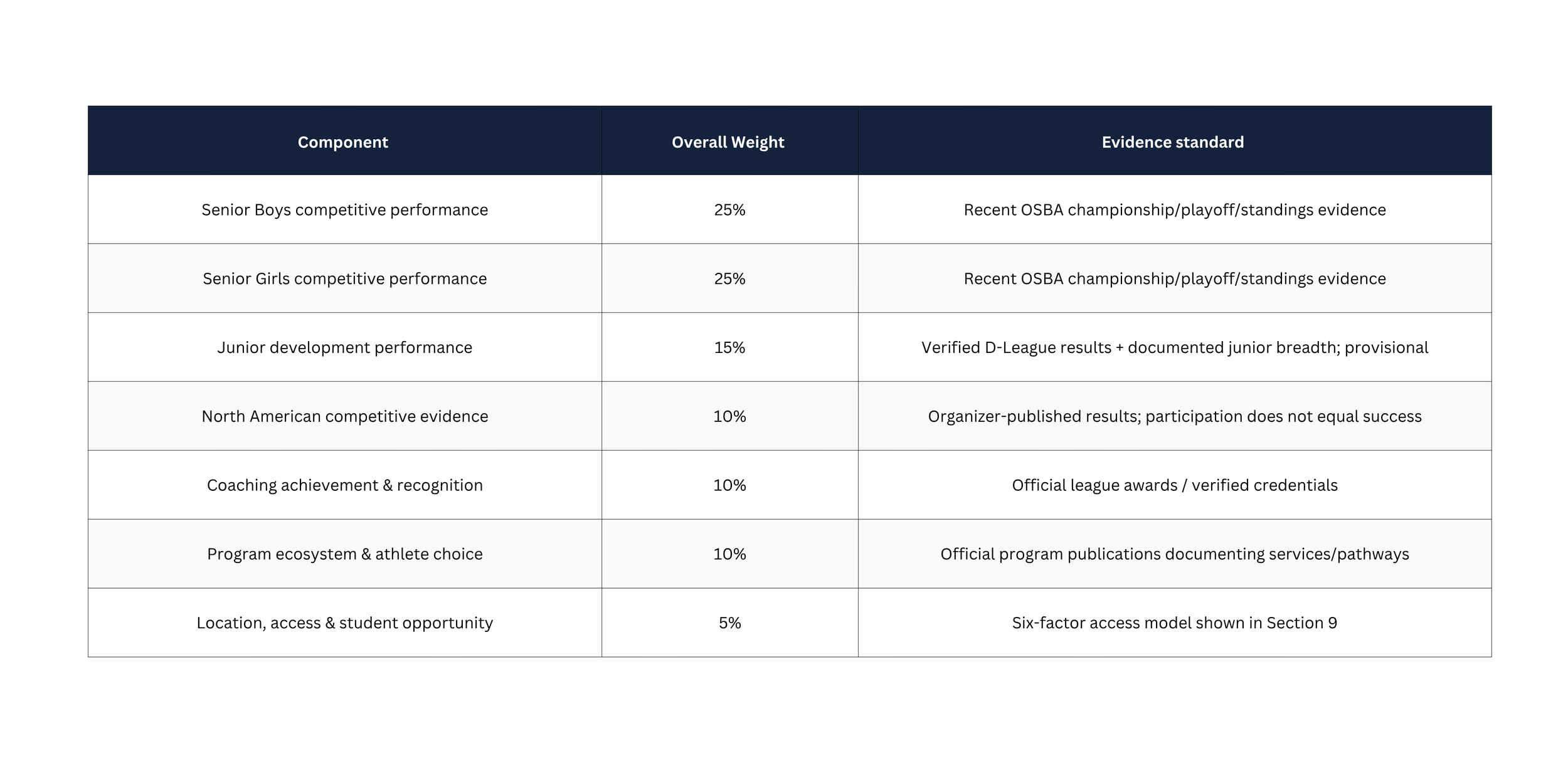
As Canada's influence on North American basketball grows, families face a more complex choice among high-school and prep programs. Team reputation alone is not enough. A meaningful comparison should consider verified competitive performance, coaching achievement, junior-to-senior development pathways, program breadth, and the educational, residential, and geographic opportunities surrounding the athlete. The Canada Basketball Program Benchmark 2026 was created to organize those factors using publicly verifiable evidence.
The 2026 comparison set includes Royal Crown School, Fort Erie International Academy, Crestwood Prep, Ridley College, Orangeville Prep, and Capital Courts Academy. The report is a market benchmark, not an official league ranking. It asks which programs demonstrate the strongest combination of recent competitive results, coaching recognition, development breadth, and student-athlete opportunity based on publicly verifiable evidence.
Overall 2026 Program Benchmark
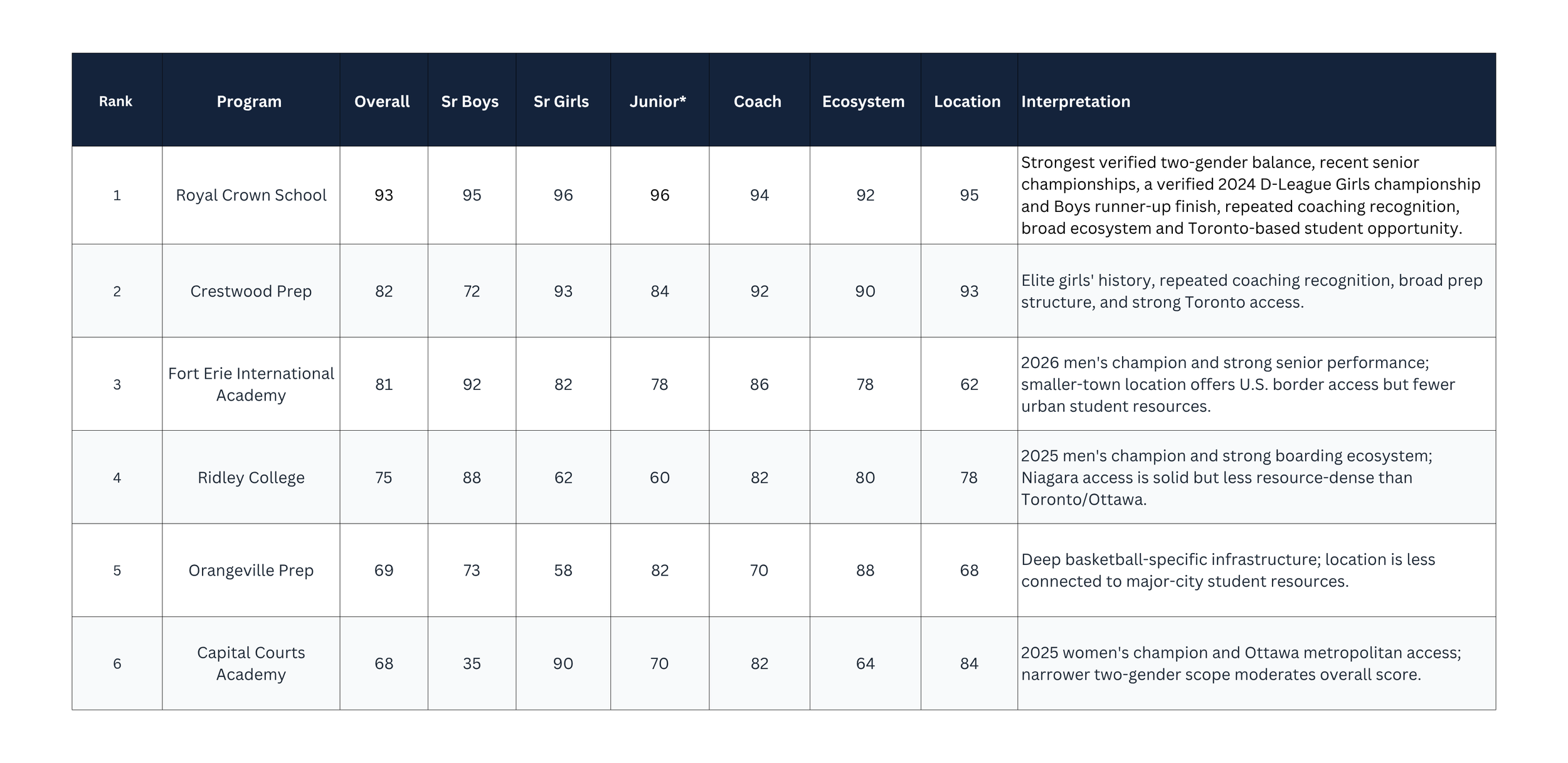
* Junior scores remain provisional evidence indices because historical D-League public records are less complete than senior records.
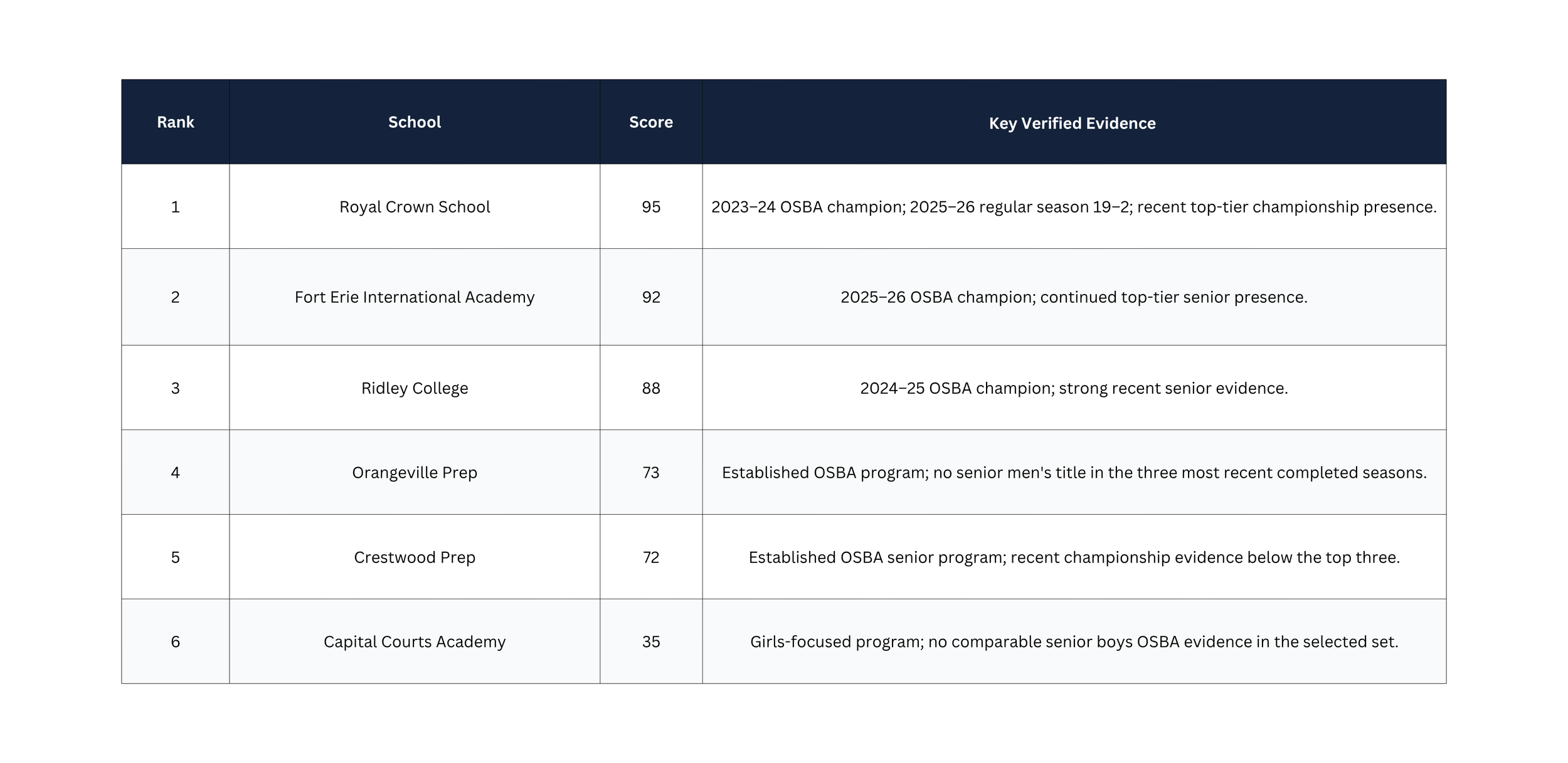
Senior Boys Ranking
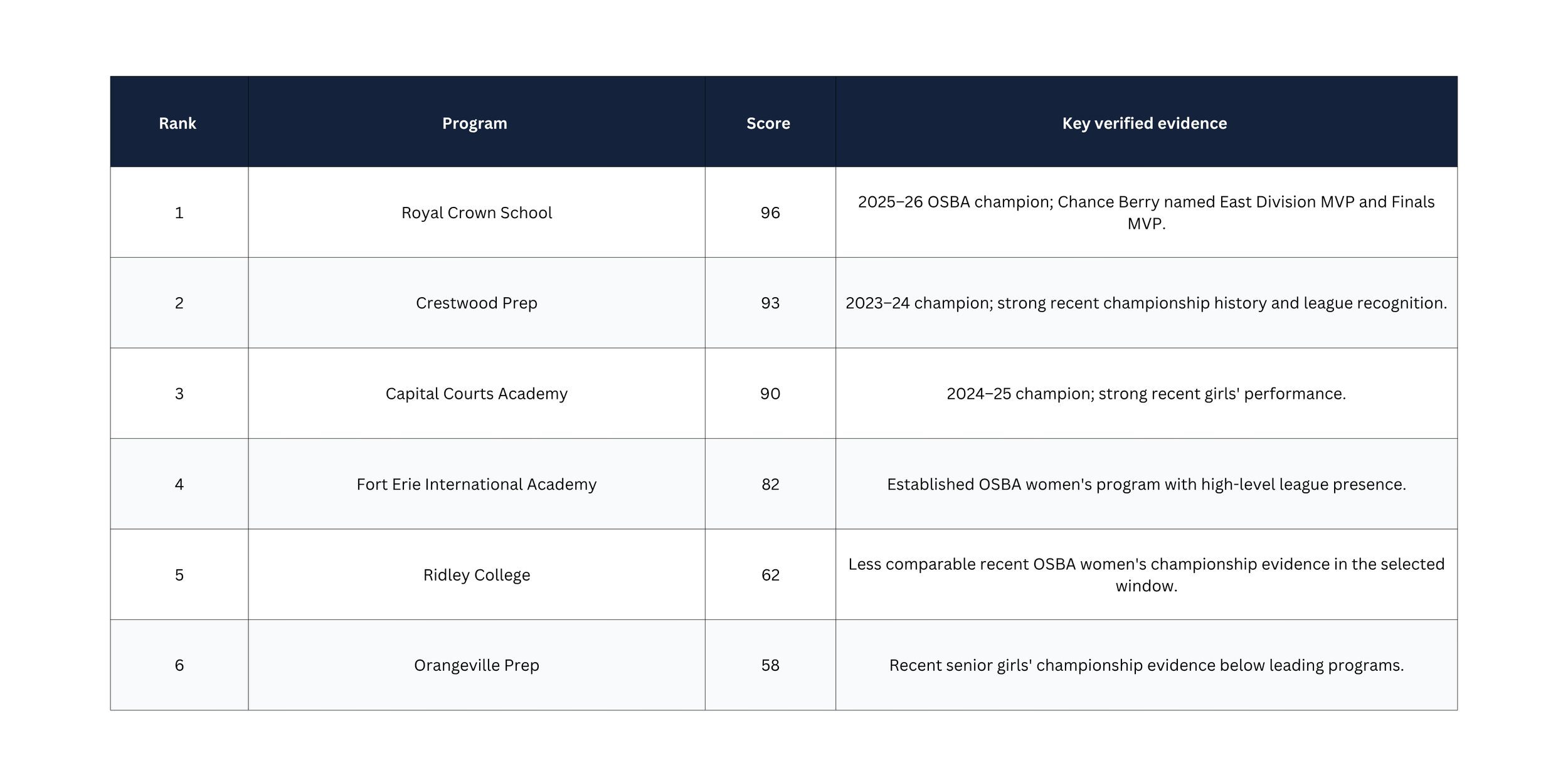
Senior Girls Ranking
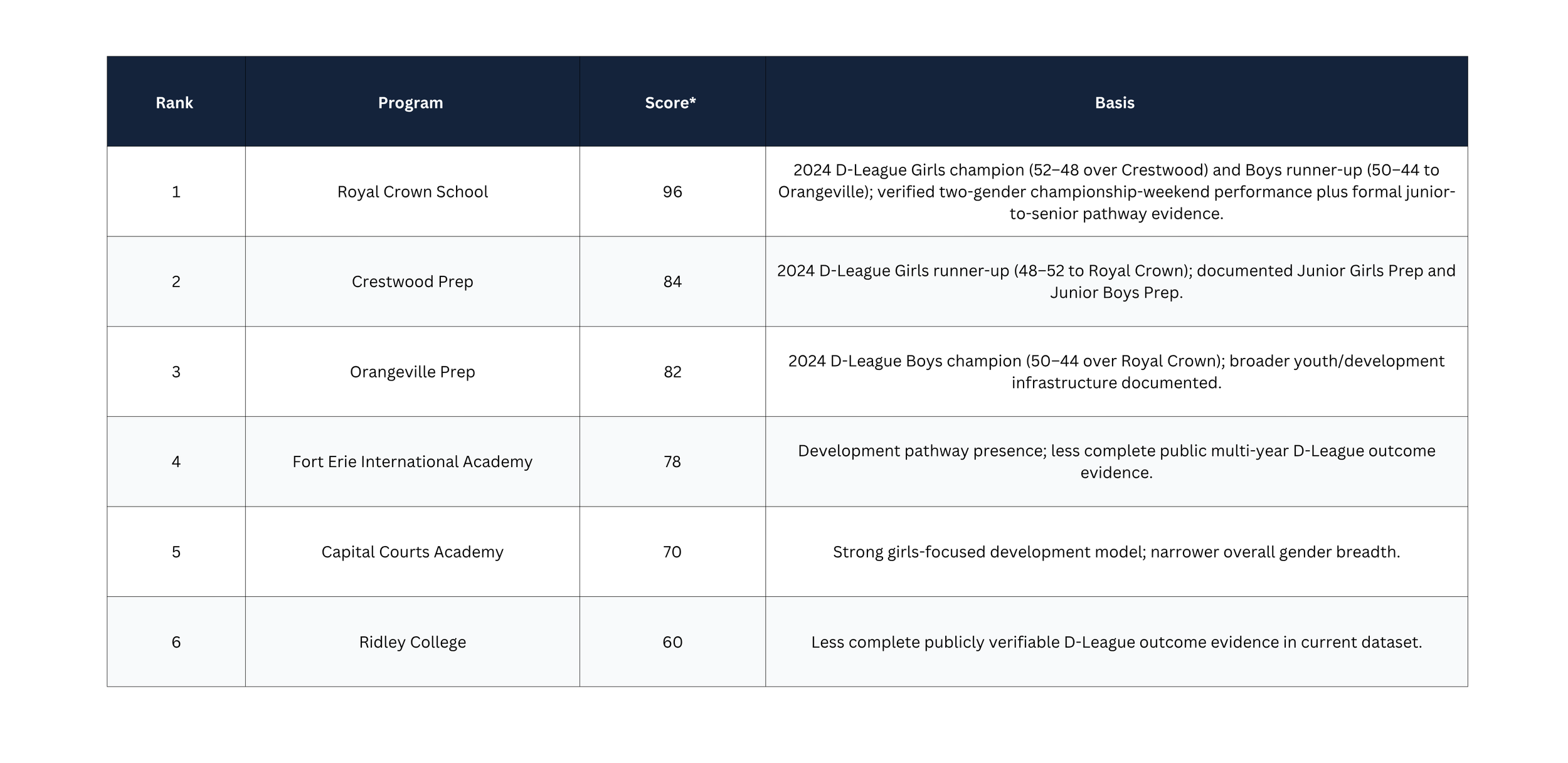
Junior Development Ranking — Provisional
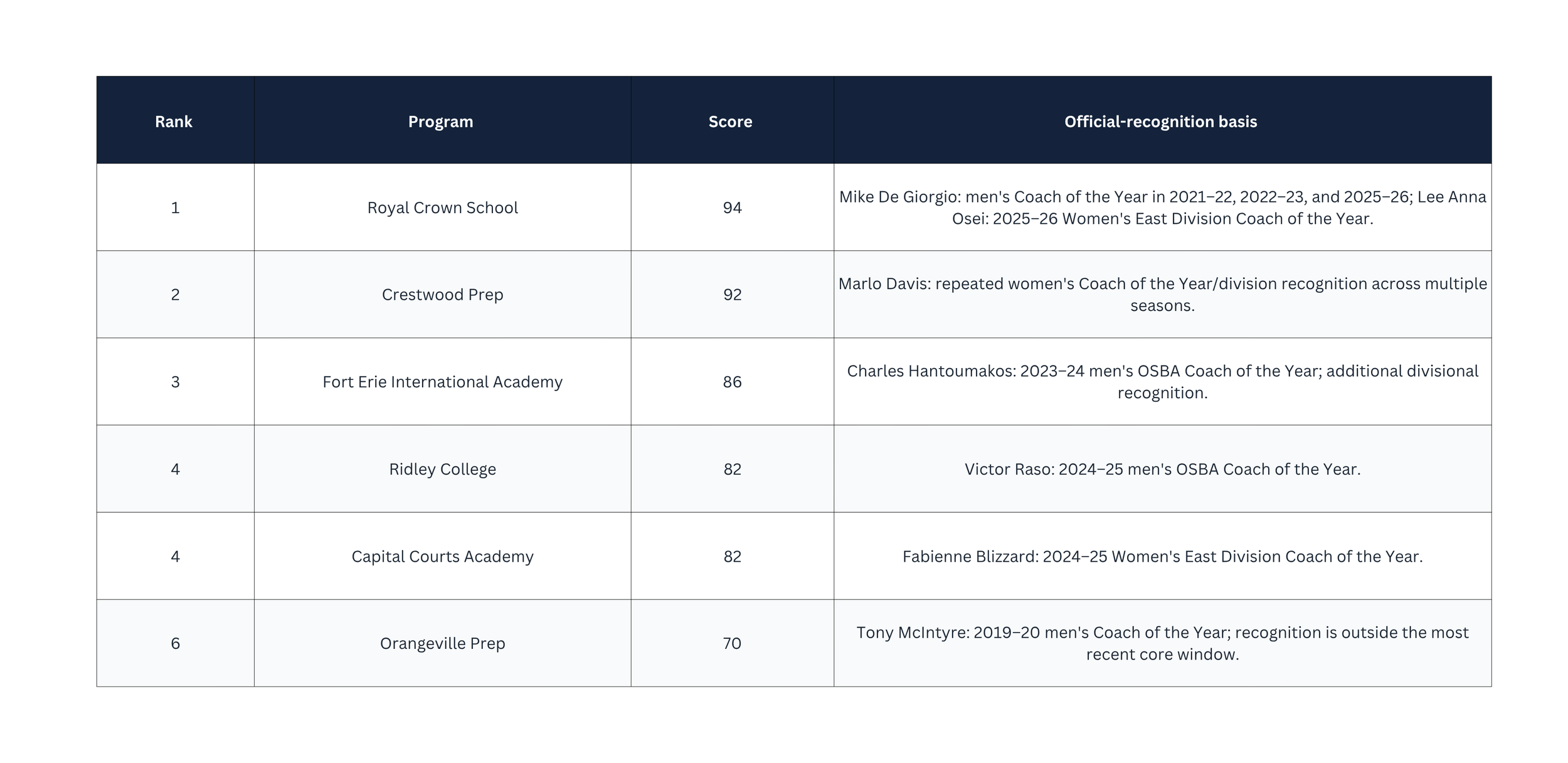
Coaching Achievement & Recognition Ranking
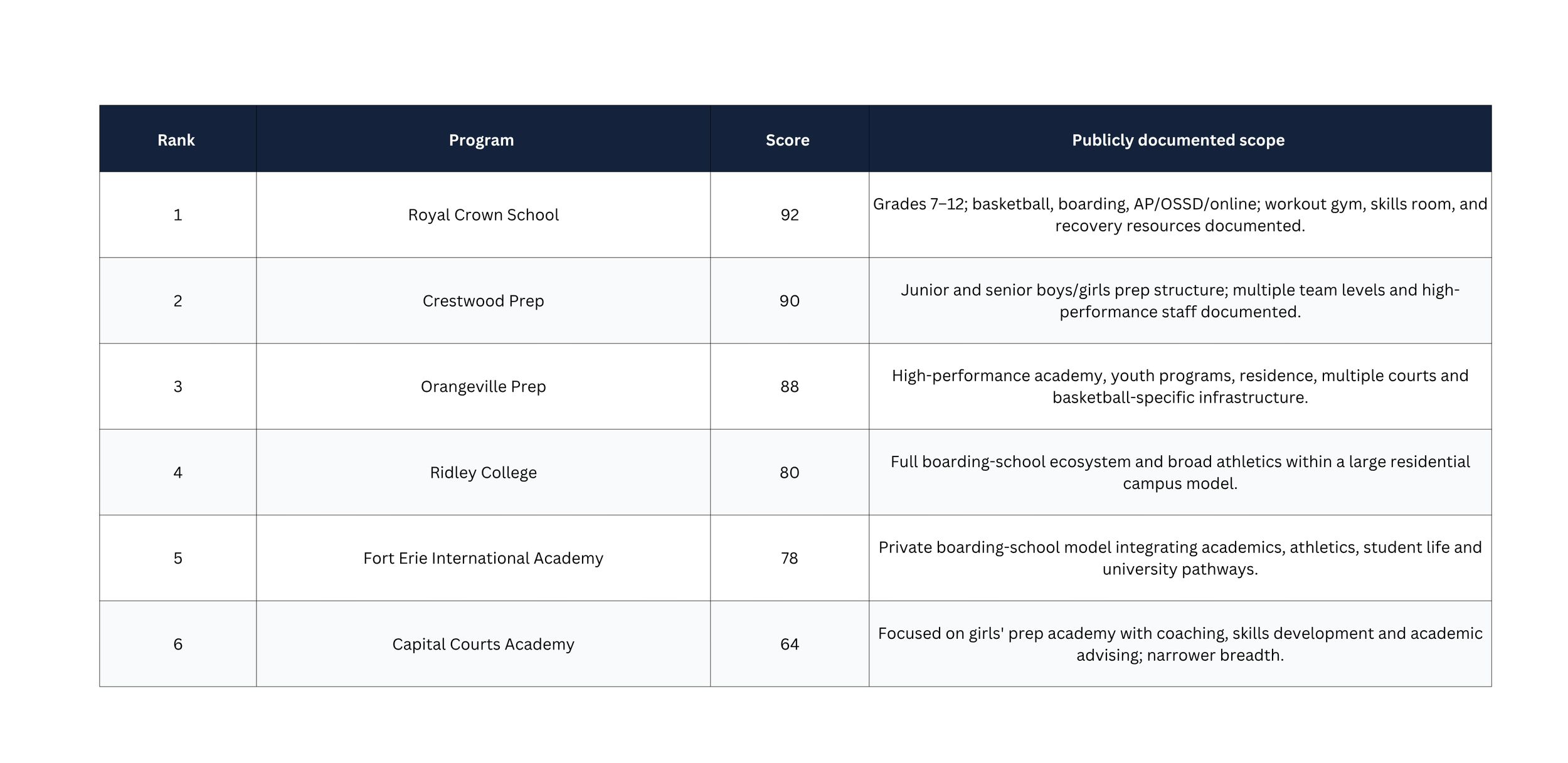
Program Ecosystem & Athlete Choice
Location, Access & Student Opportunity
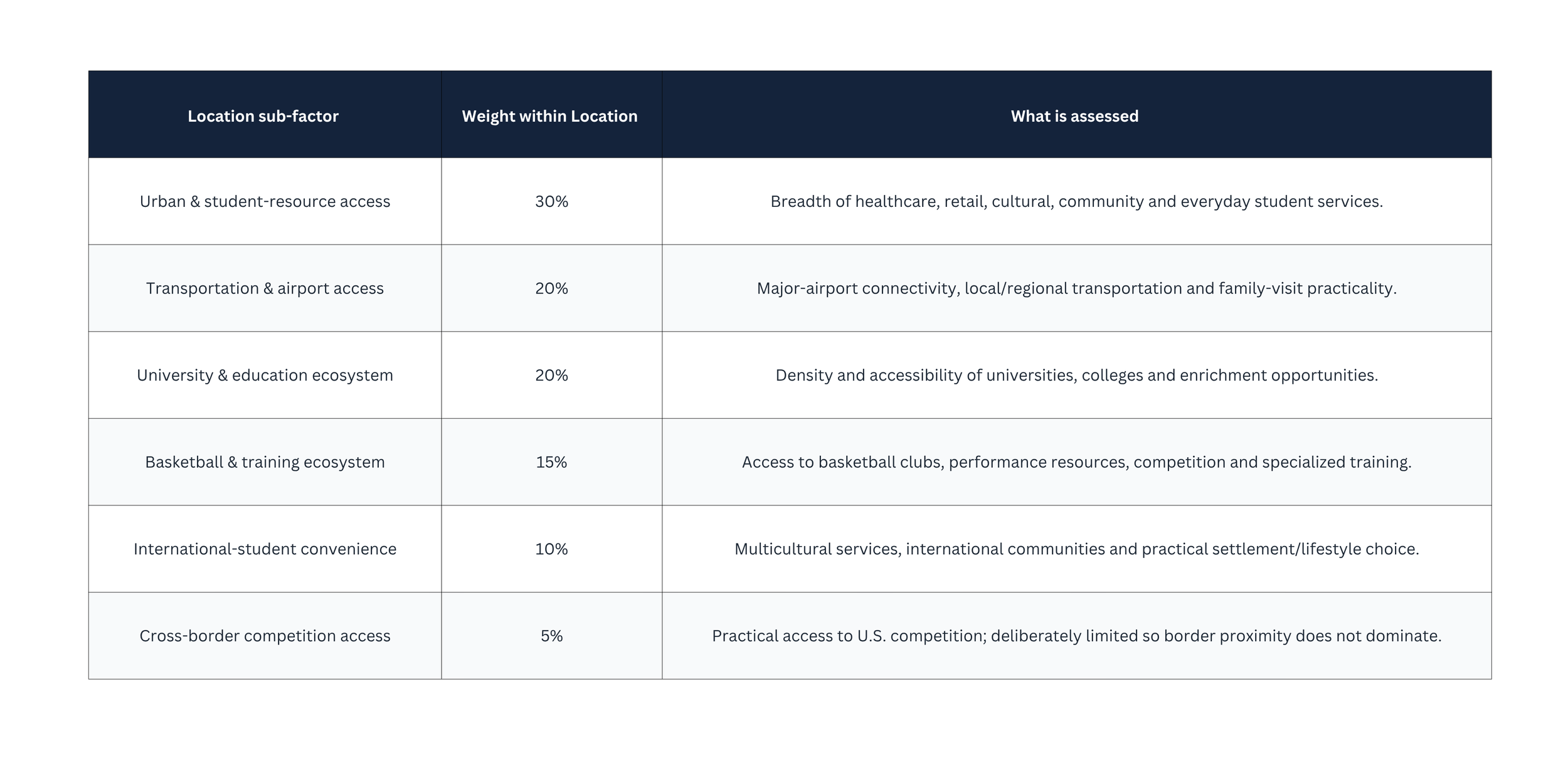
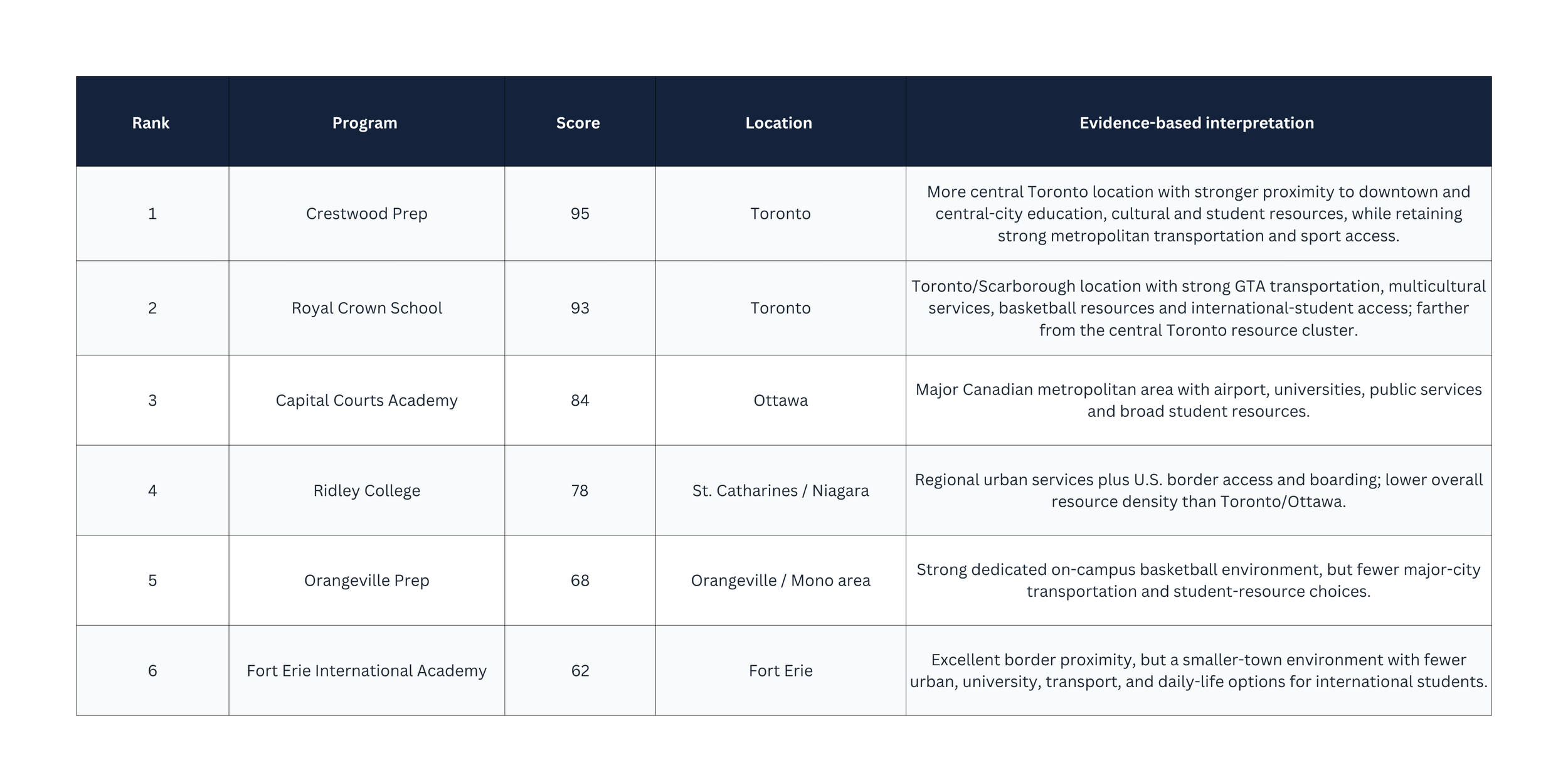
Location represents 5% of the Overall Benchmark. The category is designed from the perspective of a high-school student-athlete, particularly an out-of-region or international student. It therefore evaluates the diversity and accessibility of daily-life, educational, transportation, and sport opportunities.
Location principle
Border proximity is one travel-access variable, not a substitute for overall student opportunity. The model weights the breadth of resources a student can realistically access throughout the school year more heavily.
Scoring Methodology